This is not a reading list. A reading list tells you what to buy. Each entry here is a substantive engagement with a specific text: what it argued, what it changed, what holds up, and what a contemporary practitioner gets from reading it today.
The Haley Canon

Strategies of Psychotherapy
This is the book that established strategic therapy as a distinct clinical discipline. Haley wrote it while working on Gregory Bateson’s communication research project in Palo Alto, and the text carries the analytical intensity of that environment. The dedication page reads simply: “To Gregory Bateson.”
The book’s premise is stated plainly in its opening chapter, “Symptoms as Tactics in Human Relationships.” Symptoms are not expressions of internal pathology. They are communicative acts that position the symptomatic person within a relational system. A phobia, a compulsion, a psychosomatic complaint: each functions as a move in an ongoing negotiation over who defines the relationship.
Haley examines psychoanalysis and directive therapy through the same lens. His chapter on the strategies of psychoanalysis is the sharpest critique of the analytic method ever written by a non-analyst. He demonstrates that the analyst’s neutrality, silence, and interpretive stance constitute a specific relational strategy, one that the analyst exercises while claiming not to exercise any strategy at all. The observation is precise and difficult to refute.
The final chapter, “The Therapeutic Paradoxes,” lays out the logic that became the foundation of paradoxical intervention. Every form of therapy, Haley argues, involves paradox: the therapist asks the patient to change by being spontaneous, which is a contradiction. The therapeutic paradoxes succeed because they place the patient in a position where all available responses lead toward improvement.
For the contemporary practitioner, Strategies of Psychotherapy is essential reading because it teaches a way of seeing. After reading it, the practitioner watches therapy sessions differently. The relational moves become visible. The strategies that were invisible become obvious. The book does not age because human relationships do not change their fundamental structure.
Problem-Solving Therapy
Where Strategies of Psychotherapy was analytical, Problem-Solving Therapy is instructional. Haley wrote it after years of clinical practice and teaching at the Philadelphia Child Guidance Clinic, working alongside Salvador Minuchin and Braulio Montalvo. The book is a manual for how to do strategic therapy, step by step.
The first chapter, “Conducting the First Interview,” is a masterclass in clinical assessment. Haley lays out the specific questions to ask, the specific observations to make, and the specific decisions to reach before the session ends. The chapter on “Giving Directives” is the most detailed treatment of the therapeutic directive in the literature, covering straightforward, paradoxical, and metaphorical directives with examples from clinical practice.
The conceptual shift from Strategies to Problem-Solving Therapy is the move from the dyad to the triad. Haley argues that the minimum unit of analysis for any clinical problem is three people: the symptom-bearer, the person most affected by the symptom, and a third party whose involvement maintains the pattern. This triangular analysis changes how a practitioner reads every case. A depressed wife is not an individual with a mood disorder. She is one vertex of a triangle that includes her husband and her mother, and the depression serves a function within that triangular structure.
The book also contains Haley’s most sustained treatment of training and supervision. His chapter on “Problems in Training Therapists” argues that therapy training should be organized around live supervision of actual cases, not around theoretical seminars and personal therapy. The argument was controversial when published and remains controversial today.
Problem-Solving Therapy is the book that most practitioners trained in the strategic tradition read first and return to most often. It is practical, specific, and applicable to cases the reader will see this week.
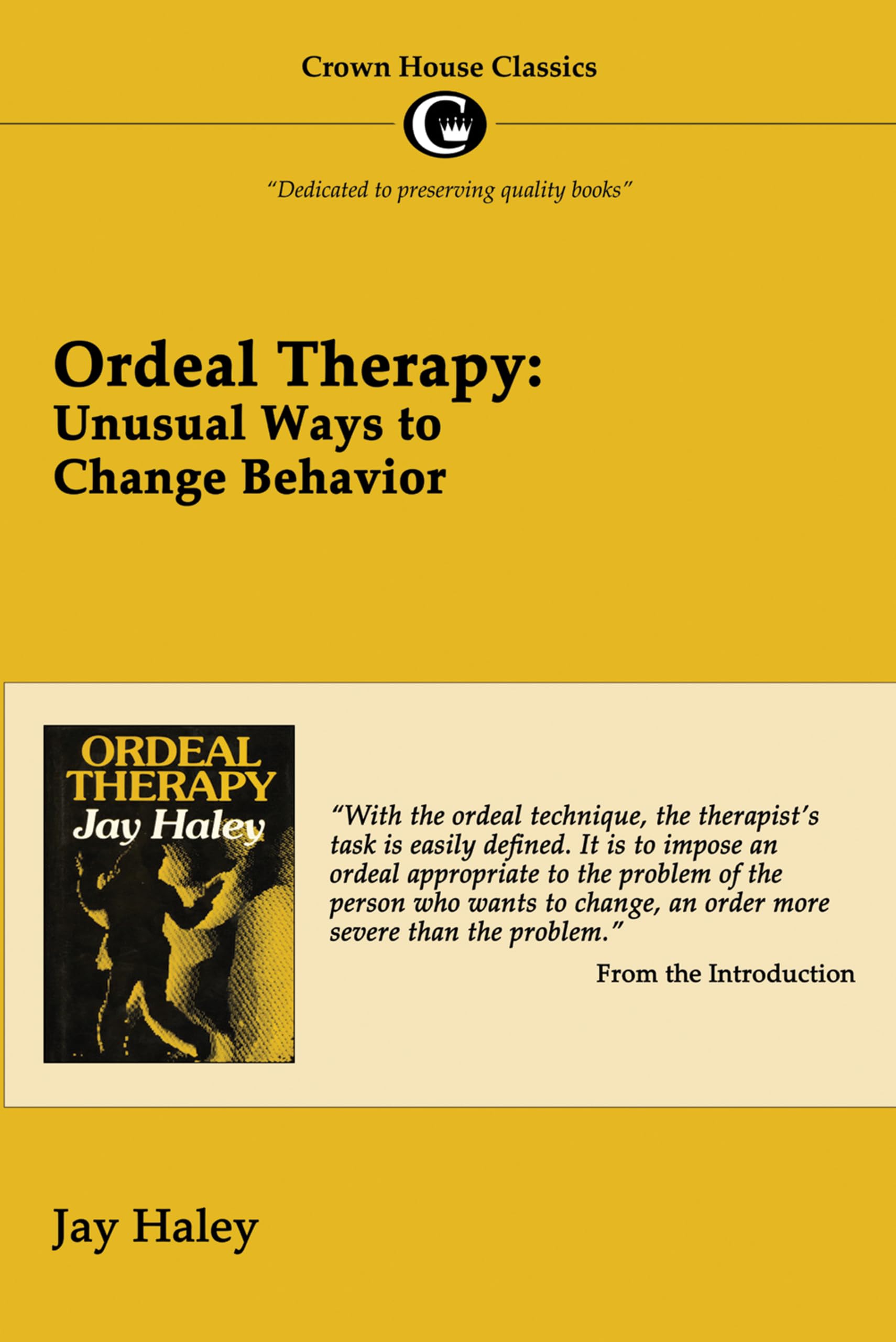
Ordeal Therapy
Haley described Ordeal Therapy in his preface as “a book about the absurd dilemmas people find themselves in and the absurd solutions offered them in therapy.” The tone is drier than his other books, and the technique it describes is the most direct in the strategic repertoire.
The ordeal technique rests on a simple principle. If the therapist can impose an ordeal on the client that is more unpleasant than the symptom, the client will give up the symptom to avoid the ordeal. An insomniac who is instructed to scrub the kitchen floor every night they cannot sleep discovers that sleep becomes easier. The technique works because the calculus changes: maintaining the symptom now carries a cost that exceeds the cost of recovery.
Haley traces the ordeal principle through Erickson’s clinical work, through religious practices of penance and purification, and through the structural logic of behavioral change. He demonstrates that the ordeal is not cruel. The client chooses the ordeal over the symptom, and the choice itself is therapeutic.
The book’s case examples cover a range that surprises readers who expect therapy to be gentle. A man with compulsive handwashing is assigned to wash his hands for an additional two hours each time the compulsion strikes. A woman with a binge-eating pattern is assigned to donate money to a cause she despises every time she binges. The interventions sound harsh on paper. In practice, they resolve symptoms that years of supportive therapy have left untouched.
Ordeal Therapy is the book for practitioners who have reached the limits of empathic approaches and need a technique that works with clients who will not respond to warmth, insight, or support. It requires clinical courage and precise judgment. Both are developed by studying the cases Haley presents.
The Art of Strategic Therapy
This is Haley’s final major work, and it reads differently from the earlier books. Where Problem-Solving Therapy lays out principles, The Art of Strategic Therapy shows the principles in action across a series of detailed case studies. The reader sits behind the one-way mirror with Haley as he supervises therapists working with families.
Michael P. Nichols, writing the foreword, notes that the strategic therapy of the 1980s had been reduced by many practitioners to a set of formulaic paradoxical prescriptions. “This tactic left many people cold, myself included,” he writes. The book exists to demonstrate that strategic therapy is not a set of techniques. It is a way of thinking about clinical problems that produces different interventions for every case.
The collaboration with Madeleine Richeport-Haley, an anthropologist, adds a cross-cultural dimension that the earlier books lack. Case studies include families from diverse cultural backgrounds, and the book addresses how strategic principles apply when the client’s worldview includes spirit possession, faith healing, and shamanic traditions. The point is not exotic illustration. The point is that the strategic framework is flexible enough to accommodate any cultural context because it operates at the level of relational structure, not cultural content.
For practitioners, the book’s value is in the specificity of its clinical observations. Haley’s supervisory comments, delivered in real time as therapists work with families, demonstrate the granular clinical thinking that separates competent strategic practice from textbook application.
Uncommon Therapy
Uncommon Therapy is Haley’s account of Milton Erickson’s clinical methods, organized around the stages of the family life cycle. It is the book that introduced Erickson to a broad professional audience and established the bridge between Ericksonian technique and strategic therapy.
Haley spent seventeen years studying Erickson’s work before writing this book. The result is not a hagiography. It is a systematic analysis of how Erickson’s interventions worked, presented through detailed case examples organized by the developmental stages at which problems arise: courtship, early marriage, childbirth, parenting, middle age, and old age.
The organizing framework is Haley’s contribution, not Erickson’s. Erickson worked case by case, improvising interventions to fit each client’s specific circumstances. Haley demonstrated that beneath the improvisation lay a consistent clinical logic: the utilization of the client’s own behavior, the use of directives to produce behavioral change, and the treatment of the presenting problem as the target rather than as a symbol of deeper pathology.
Uncommon Therapy remains one of the most widely read books in the brief therapy literature. Its case examples are vivid, often startling, and they demonstrate a level of clinical creativity that most training programs do not teach. For practitioners who want to understand what is possible in a therapeutic encounter, this book expands the boundary of imagination.
The Ericksonian Tradition
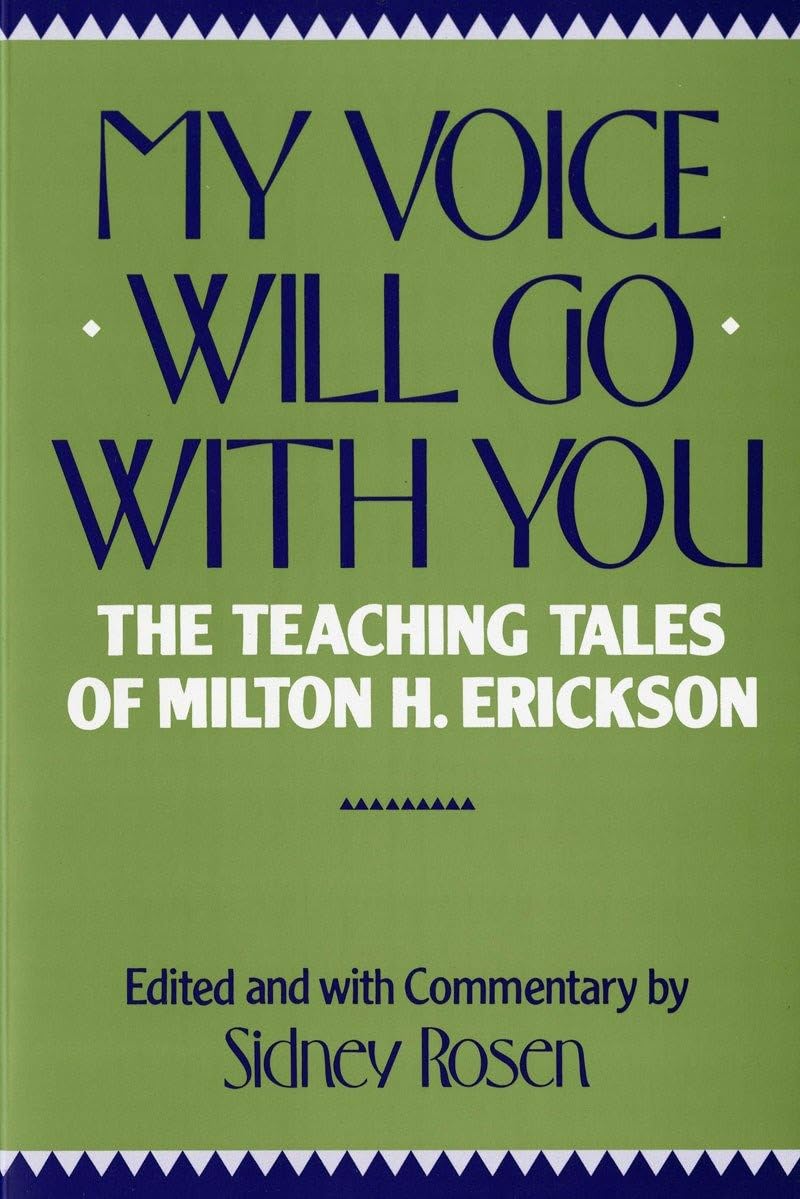
My Voice Will Go With You
Sidney Rosen collected the teaching tales that Erickson used in seminars, workshops, and private conversations over decades of teaching. The result is the most accessible entry point into Erickson’s clinical thinking.
Erickson taught through stories. A student who asked how to handle a resistant client received a story about a horse that wandered onto the family farm when Erickson was a boy. He guided the horse back to its owner by following the horse’s own path and only correcting its direction when it strayed. The story communicates the utilization principle more effectively than any textbook definition.
The tales in this collection cover the full range of Erickson’s clinical interests: pain management, habit control, relationship problems, and the nature of therapeutic influence. Rosen provides commentary that contextualizes each story within Erickson’s broader clinical framework, but the stories speak for themselves.
For practitioners, My Voice Will Go With You demonstrates how metaphor functions as a therapeutic tool. The stories are not decorative. They carry interventions embedded within their structure, and the practitioner who studies them develops a clinical capacity for delivering therapeutic messages through indirect means.
Systems and Communication
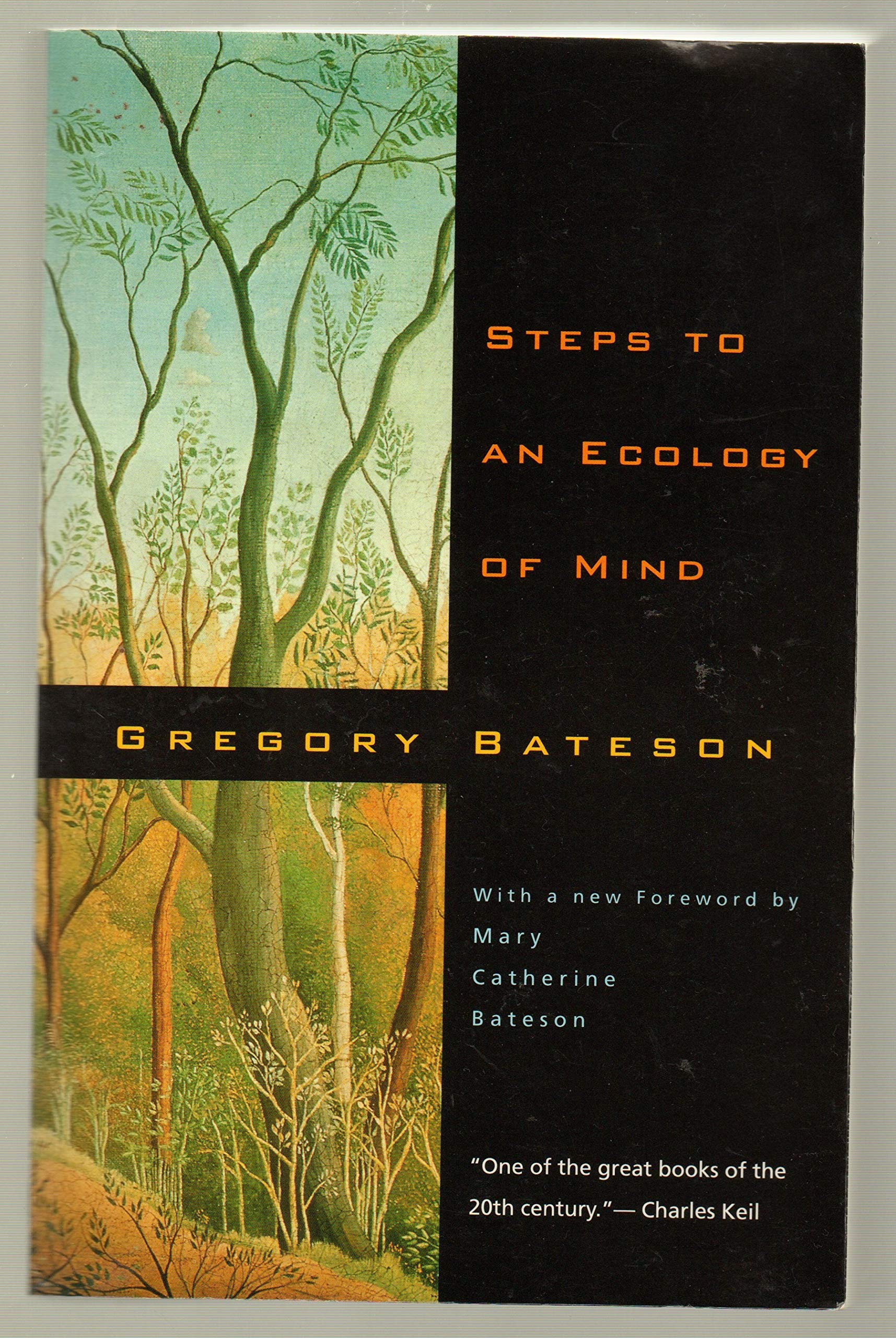
Steps to an Ecology of Mind
This collection of Bateson’s papers, essays, and metalogues spans his career from Balinese anthropology through cybernetics to the communication research that produced the double-bind theory. The book is not easy reading. Bateson wrote for an audience that shared his comfort with abstraction, and he did not simplify.
The papers most relevant to strategic therapy are those written during and about the Palo Alto research project: “Toward a Theory of Schizophrenia” (the original double-bind paper), “The Group Dynamics of Schizophrenia,” and “Minimal Requirements for a Theory of Schizophrenia.” These papers establish the communication framework that Haley later developed into a clinical method.
Bateson’s broader contribution is the systems perspective itself: the insistence that behavior cannot be understood in isolation from context, that communication operates on multiple levels simultaneously, and that the patterns connecting living systems are more important than the elements they connect. This perspective is the intellectual foundation of strategic therapy, even though Bateson himself was ambivalent about clinical applications.
Steps to an Ecology of Mind is the book for practitioners who want to understand the theoretical roots of the strategic approach. It is demanding, occasionally opaque, and permanently useful once understood.
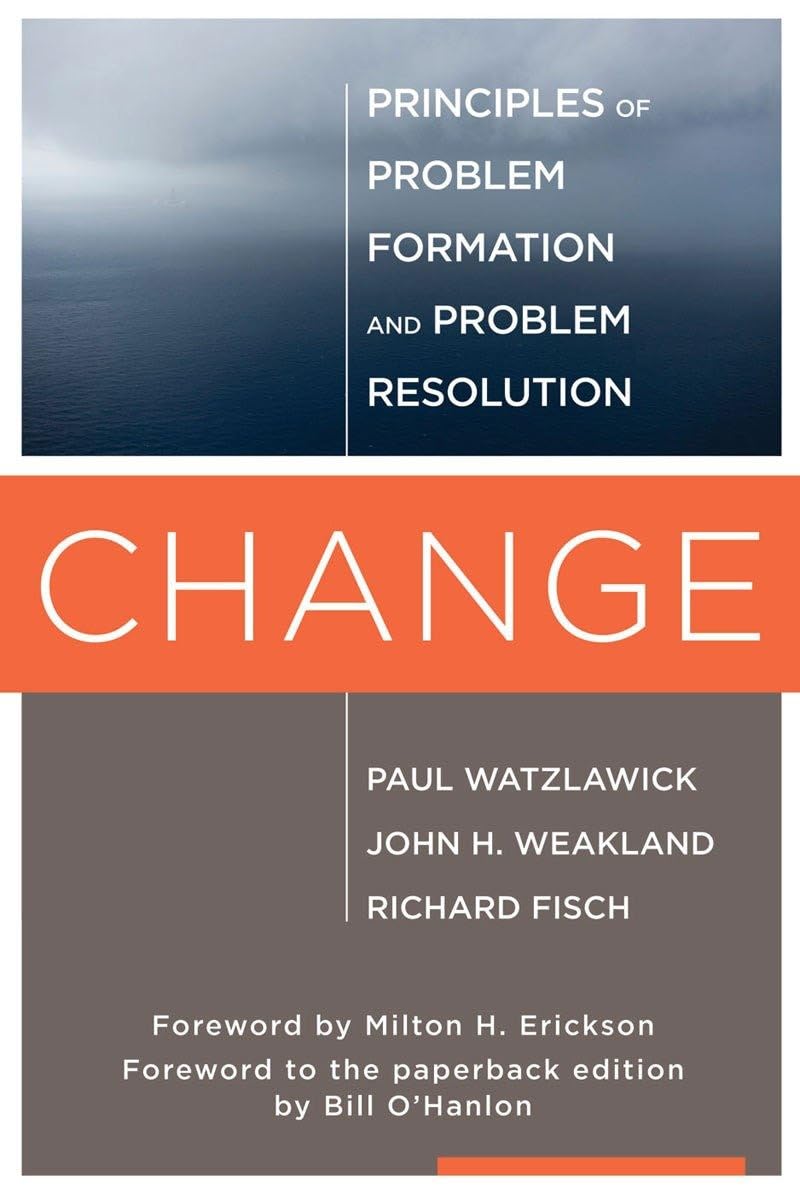
Change: Principles of Problem Formation and Problem Resolution
Change is the theoretical manifesto of the MRI brief therapy model. The book distinguishes between two types of change: “first-order change,” which occurs within an existing system and does not alter the system’s structure, and “second-order change,” which alters the system itself.
The central clinical insight is that most problems persist because of first-order change attempts. The more the client tries to solve the problem using the same logical framework, the more entrenched the problem becomes. Second-order change requires stepping outside the framework, and this is what therapeutic intervention accomplishes.
The book’s most useful concept for practitioners is the “attempted solution” analysis. When a client presents with a problem, the first clinical question is: what has the client been doing to try to solve it? The attempted solution is almost always maintaining the problem, and interrupting the attempted solution is often sufficient to resolve it.
Change is brief, clearly written, and clinically applicable. It is the best single introduction to the MRI model and the most efficient route to understanding the theoretical difference between the MRI approach and Haley’s strategic approach.
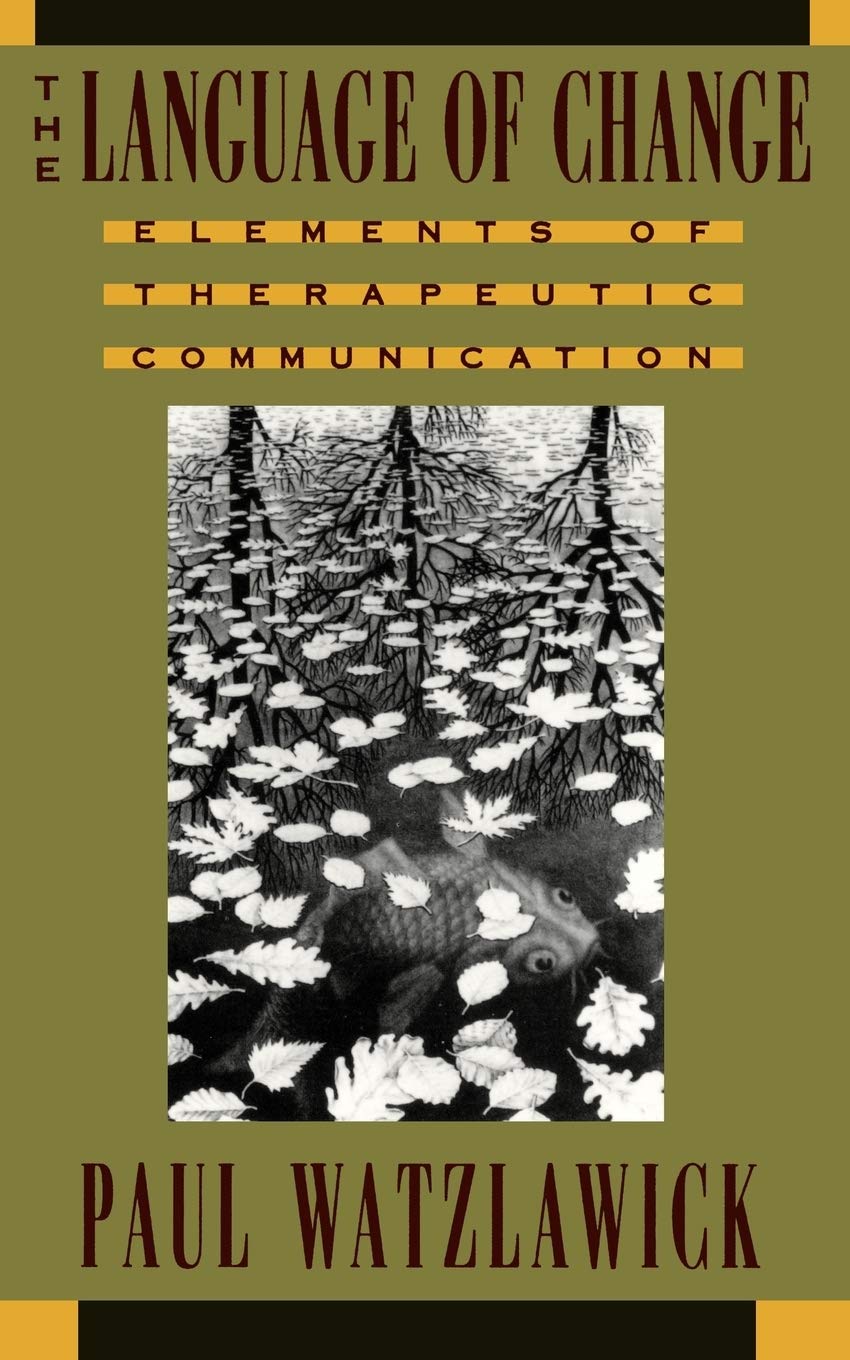
The Language of Change
Watzlawick’s focus in this book is on how therapeutic communication produces change. Drawing on research in hemispheric specialization, he argues that the language of change operates through the right hemisphere: through imagery, metaphor, and analogical communication rather than through logical argument.
The book provides a theoretical rationale for why direct advice often fails and why indirect communication, metaphor, and reframing succeed. A client who is told “stop worrying” cannot comply because the instruction is processed by the same cognitive system that produces the worrying. A client who receives a metaphorical communication or a paradoxical task bypasses the cognitive system and engages the behavioral patterns directly.
For practitioners, The Language of Change provides a framework for understanding why strategic interventions work at the level of communication theory. It is more theoretical than Change but more clinically oriented than Bateson’s Steps to an Ecology of Mind. It occupies the middle ground between theory and practice and is useful for practitioners who want to understand the mechanism behind the techniques they use.

Strategic Family Therapy
Cloe Madanes co-founded the Family Therapy Institute in Washington, D.C., with Haley and developed her own distinctive contribution to the strategic tradition. Strategic Family Therapy extends Haley’s framework with particular attention to the use of pretending and playful directives in family therapy.
Madanes introduced the technique of asking a symptomatic child to “pretend” to have the symptom while the parents “pretend” to help. The technique is paradoxical in structure but delivered through the language of play. A child who has night terrors is asked to pretend to have a night terror during the day, while the parents pretend to comfort her. The pretending restructures the family hierarchy by placing the parents in charge of the symptom without anyone having to admit that the symptom serves a relational function.
The book is particularly useful for practitioners who work with children and families. Madanes demonstrates how strategic principles apply when the identified patient is a child and the relational dynamics involve parental hierarchy, sibling coalitions, and intergenerational patterns. Her clinical examples are vivid and her therapeutic sensibility is distinct from Haley’s: warmer, more playful, and equally precise in its structural analysis.
Contemporary Practice
This section will expand as the institute’s reading list develops. The strategic and Ericksonian tradition continues to produce practitioners and writers who apply the core principles to contemporary clinical contexts, including chronic pain, trauma, and the integration of brief therapy methods with current neuroscience. Entries will be added as they meet the standard of genuine clinical substance.