What’s happening
Trauma isn’t the event. It’s what your nervous system did to keep you alive during the event, which is now running long after the event has ended. The hypervigilance, the avoidance, the numbness, the flashbacks: all of these are survival responses that haven’t received the message that the danger is over. The system that saved you then is what’s costing you now.
You’re not weak for not getting over it. You’re running adaptations that don’t have an off switch.
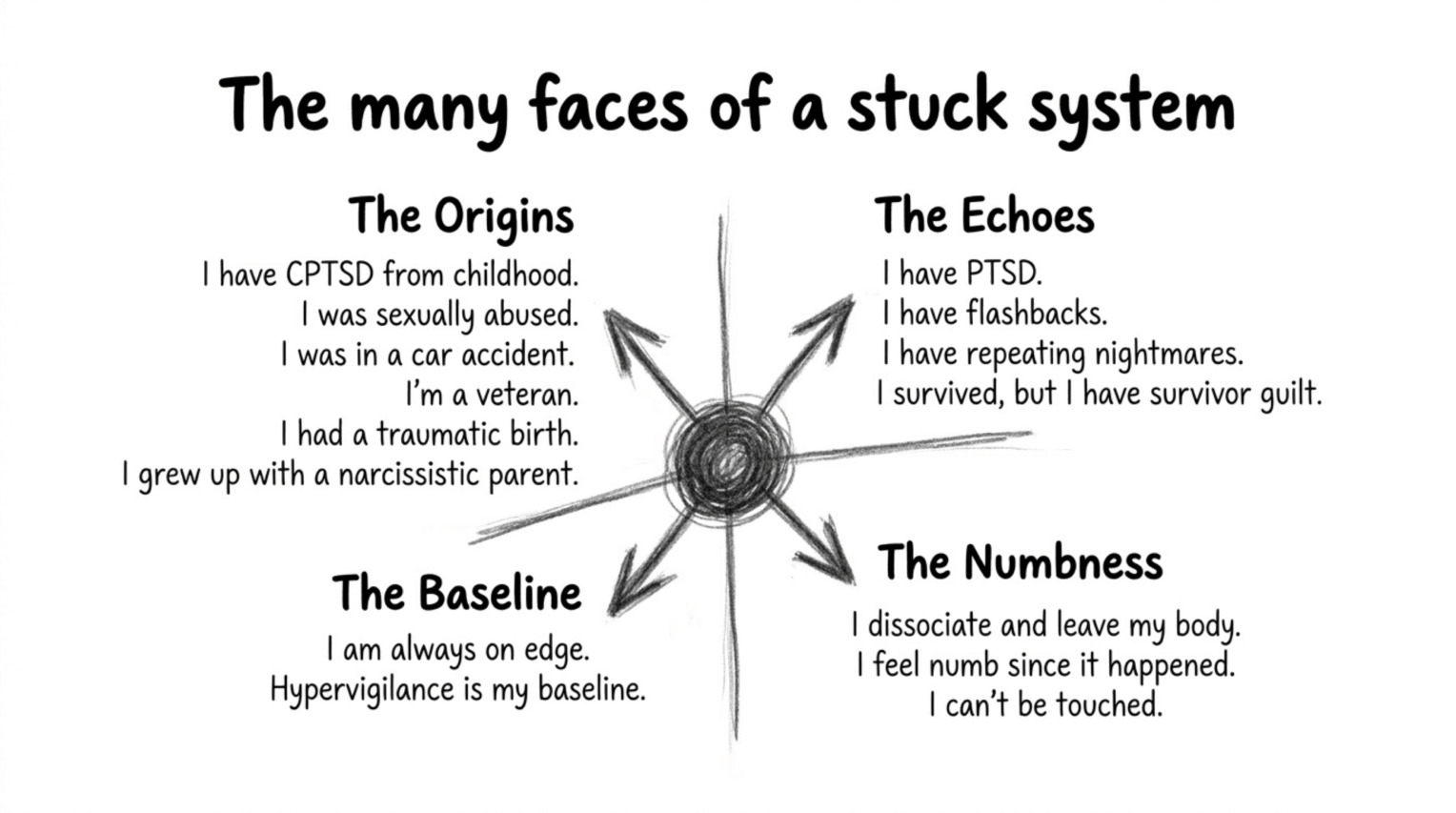
Which version of this is yours?
I have PTSD. Specific event, specific symptoms. → I have PTSD
I have CPTSD. Years of it. The trauma is the childhood, not an event. → I have CPTSD
I have flashbacks. Reliving the moment without warning. → I have flashbacks
I have nightmares about something that happened. Same dream, repeating. → I have nightmares about something that happened
I dissociate. I leave my body. I go somewhere else and come back later. → I dissociate
I feel numb since it happened. The world isn’t reaching me. → I feel numb since it happened
I was sexually abused. And the effects are still organizing parts of my life. → I was sexually abused
I was in a car accident. And driving has never been the same. → I was in a car accident
I’m a veteran with PTSD. And the standard treatments haven’t reached it. → I’m a veteran with PTSD
I’m always on edge. Hypervigilance has become my baseline. → I’m always on edge
I can’t be touched. My body has decided that touch is dangerous. → I can’t be touched
I had a traumatic birth. And nobody told me what to do with that. → I had a traumatic birth
I survived something but I can’t move on. Survivor guilt. Repeating. → I survived something but I can’t move on
I grew up with a narcissistic parent. And the patterns followed me. → I grew up with a narcissistic parent
What kind of trauma response is yours?
Educational, not diagnostic. Not a substitute for clinical assessment.
© The Institute for Applied Strategic Therapy. All rights reserved.
Why standard trauma treatment has been incomplete
Most trauma treatment focuses on processing the original event. Talking it through. Reliving it in a controlled setting. Reframing the meaning. For some people this helps. For many, the symptoms persist because the pattern your nervous system runs in response to the trauma has its own life, separate from the original event. Processing the event doesn’t always change the pattern.
You can know everything about what happened and still have the symptoms. The symptoms are the system that formed around the event, not the event itself.
How we work with it
Strategic therapy targets the present, not the event. We work on the patterns the trauma is running in your current life, the avoidances, the bracing, the responses your nervous system kept from when it needed them. We change what activates when the pattern fires, so the system reorganizes around present conditions rather than past ones.
The event stops being something you’re inside. It becomes something that happened to you.