Gregory Bateson was an anthropologist, a cyberneticist, and, by the standards of any single discipline, an outsider. His research career spanned cultures, species, and fields of inquiry. He studied Balinese trance rituals, dolphin communication, and schizophrenic families with equal rigor. His contribution to psychotherapy was indirect but foundational: he gave clinicians a way to think about human problems as properties of systems rather than properties of individuals.
The Communication Research Project
In 1952, Bateson assembled a small research group at the Veterans Administration Hospital in Palo Alto, California. The project studied communication patterns, initially in animal behavior and cultural rituals, and progressively in psychiatric contexts. The full-time members were Bateson, Jay Haley, and John Weakland. Don D. Jackson and William F. Fry served as psychiatric consultants.
The group stayed together for a decade and produced a body of work that changed the conceptual landscape of psychotherapy. Their central publication, “Toward a Theory of Schizophrenia” (1956), introduced the double-bind hypothesis. The paper argued that schizophrenic behavior could be understood as a logical response to contradictory communication patterns within families, particularly when those contradictions occurred in relationships the individual could not leave.
The double-bind concept achieved something rare in the history of psychiatry. It offered an explanation for psychotic behavior that did not require reference to intrapsychic pathology, neurological deficit, or genetic predisposition. The explanation was relational. The problem was not inside the person. The problem was in the communication structure surrounding the person.
Bateson reframed mental illness as a communication problem, not a character flaw. That shift made strategic therapy possible.
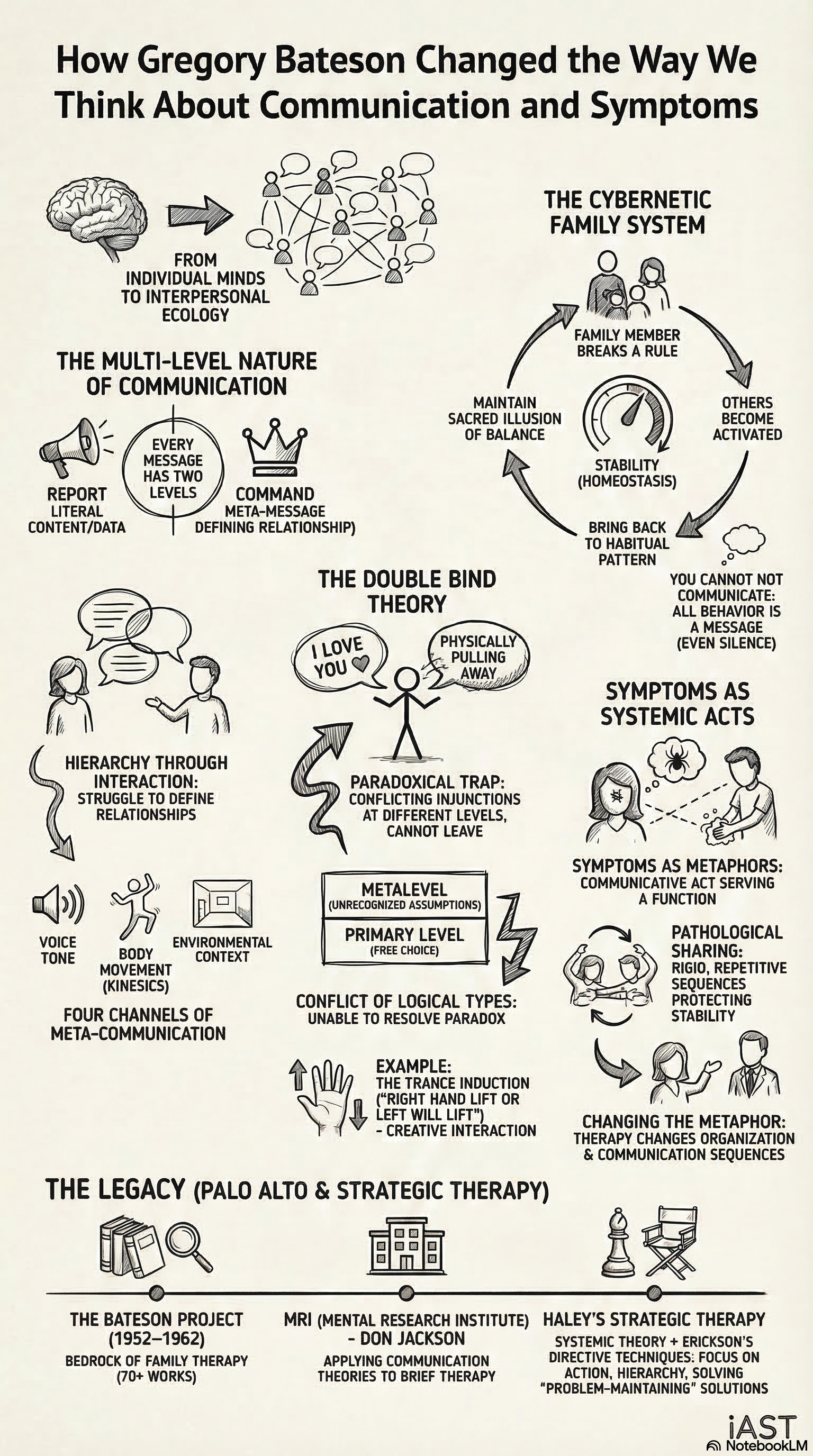
Cybernetics and Circular Causality
Bateson imported the cybernetic concept of feedback loops into the study of human interaction. Classical psychiatry operated on linear causality: a trauma causes a symptom, an unconscious conflict produces anxiety. Bateson proposed circular causality: behaviors in a system influence each other recursively, and the “cause” of any pattern is the pattern itself.
This framework changes how a practitioner reads a presenting problem. Linear thinking asks: what happened to this person to make them anxious? Circular thinking asks: what interaction patterns maintain this person’s anxiety, and who else participates in those patterns? The first question leads to excavating the past. The second question leads to intervening in the present.
Haley absorbed this orientation during his ten years on the Bateson project, and it became the structural logic of strategic therapy. The symptom is maintained by the system. Change the system, and the symptom loses its function.
Levels of Communication
Bateson distinguished between the content of a message and the relational signal that accompanies it. Every communication operates on at least two levels: what is being said, and what the act of saying it implies about the relationship between speaker and listener. A mother who says “I want you to be independent” while controlling every decision communicates a paradox. The verbal content says one thing. The relational behavior says the opposite.
This analysis of communication levels became a core diagnostic tool in strategic therapy. When a client presents with a symptom, the strategic practitioner listens for the relational message the symptom conveys. Depression in a marriage communicates something about the marital structure. A child’s school refusal communicates something about the family hierarchy. The symptom is a message delivered at the relational level, and the practitioner who ignores the relational level misses the information that matters most.
Bateson’s Influence on Clinical Practice
Bateson himself was ambivalent about clinical applications of his work. He was a theorist and a researcher, not a therapist. He declined to join the Mental Research Institute when Don Jackson founded it in 1959, and he was uncomfortable with the way his communication ideas were sometimes reduced to clinical techniques.
His influence on strategic therapy came through Haley, who worked alongside Bateson for a decade and then spent the rest of his career building a clinical method from the concepts they developed together. The systems perspective, the analysis of communication levels, the emphasis on present interaction over historical causation: these ideas entered clinical practice through Haley’s books and teaching, and they remain the intellectual infrastructure of the strategic approach.
Bateson’s broader intellectual project, articulated most fully in Steps to an Ecology of Mind (1972), was to understand the patterns that connect living systems. For clinicians, the practical lesson is specific: when a practitioner stops asking “What is wrong with this individual?” and starts asking “What pattern is this individual embedded in?”, the available interventions multiply. The problem becomes a property of the system, and systems can be rearranged.