Milton H. Erickson practiced psychiatry in Phoenix, Arizona, for nearly five decades. He saw clients in an office attached to his home, often working late into the evening, treating a range of presentations that most clinicians of his era would not have touched. He worked with chronic pain patients, psychotic individuals, resistant adolescents, and couples in crisis. His success rate was difficult to explain using the theoretical frameworks available at the time, and most of his colleagues did not try. They simply sent him their difficult cases.
The Utilization Principle
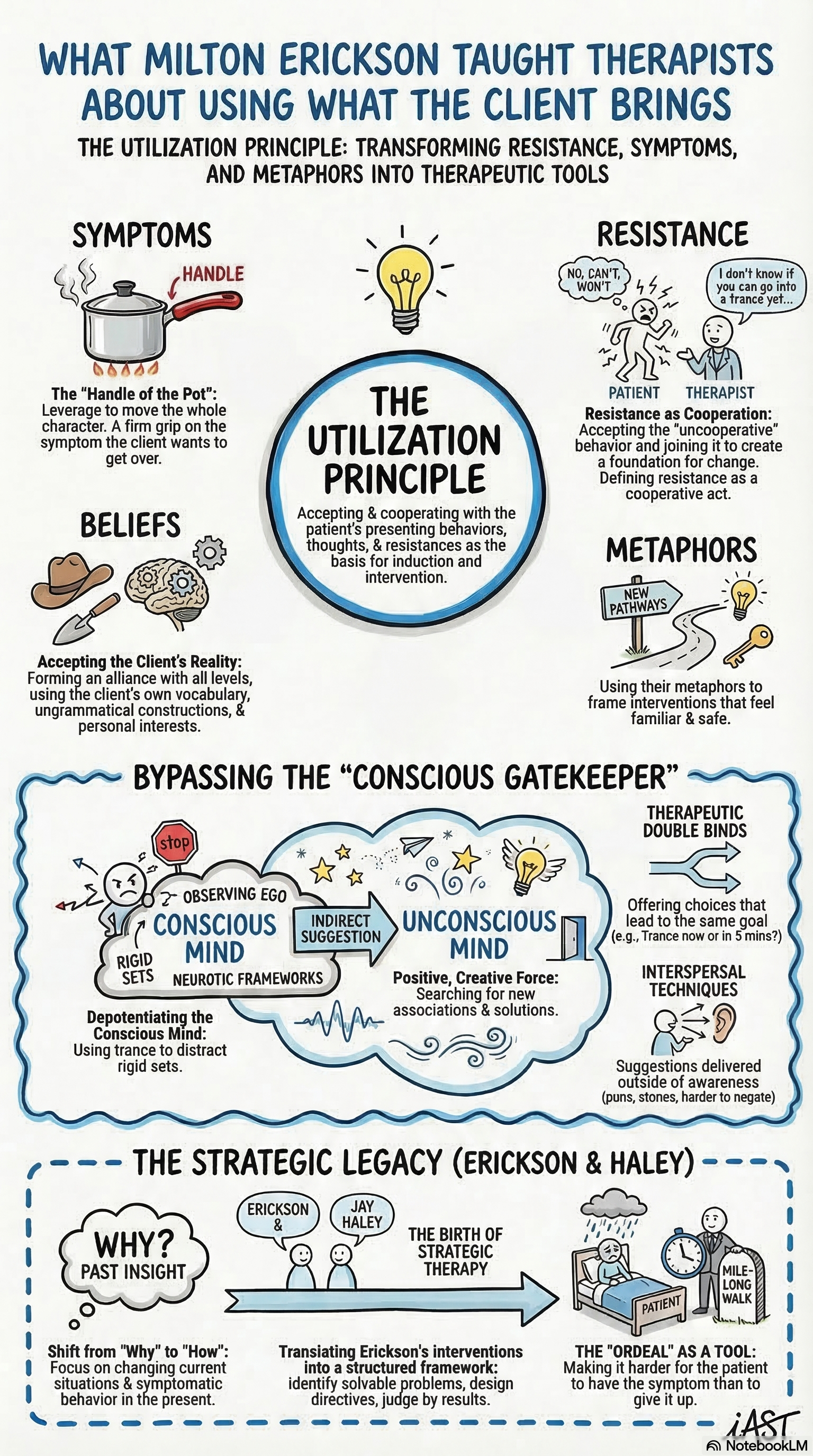
Erickson’s central contribution to clinical work is the principle of utilization. Every client brings material into the session: their symptoms, their resistance, their beliefs, their behavioral patterns, their language. Most therapeutic approaches treat some of this material as obstacles. Erickson treated all of it as resources.
A client who resists every suggestion is demonstrating a capacity for opposition. Erickson would use that opposition by prescribing the symptom or by framing the directive so that resistance to the directive produces the desired change. A client who speaks in metaphor receives interventions delivered in metaphor. A client who insists on controlling the session finds that the therapist has structured the session so that control-seeking behavior leads to therapeutic outcomes.
The principle sounds simple. In practice, it requires a clinician who can read behavioral patterns in real time and construct interventions on the spot. Erickson’s genius was this improvisational capacity, and his influence on Haley was the recognition that this capacity could be studied, taught, and systematized.
Utilization means working with what the client brings rather than against it. Resistance becomes material. The symptom becomes an asset.
Indirect Suggestion and Trance
Erickson’s approach to hypnosis departed from the classical tradition. Classical hypnosis relied on direct commands: “You are getting sleepy. Your arm is rising.” Erickson used indirect suggestion, embedded commands, and conversational trance inductions that bypassed the client’s conscious resistance without requiring formal hypnotic procedures.
The relationship between symptom and trance was central to Erickson’s clinical thinking. He observed that symptomatic behavior often resembles a trance state: the phobic client who enters a panic is absorbed in an involuntary narrowing of attention. The chronic pain patient focuses on sensation to the exclusion of context. Erickson’s interventions frequently involved redirecting this absorption rather than eliminating it. The client’s capacity for trance-like focus was, in his framework, the same capacity that could produce therapeutic change.
Influence on Haley and Brief Therapy
Jay Haley first visited Erickson in the mid-1950s while working on Gregory Bateson’s communication research project. Over the next seventeen years, Haley studied Erickson’s methods, initially analyzing them through the communication lens of the Bateson project. The result was Uncommon Therapy (1973), which organized Erickson’s case work around the stages of the family life cycle and demonstrated that Erickson’s seemingly idiosyncratic techniques followed a systematic logic.
Haley recognized three things about Erickson’s work that became foundational to strategic therapy. First, the therapist is an active agent. The therapist designs the intervention, assigns the task, and takes responsibility for the outcome. Second, insight is optional. Behavioral change can occur without the client understanding why it occurred. Third, the presenting problem is the target. Erickson did not look for underlying pathology. He solved the problem the client brought through the door.
These principles separated the strategic tradition from virtually every other school of therapy in the twentieth century. Psychoanalysis required insight. Rogerian therapy required emotional processing. Behavioral therapy (in its early forms) required laboratory-derived protocols. Erickson worked with the specific material of each individual case and constructed interventions that fit that case alone.
The Ericksonian Tradition Today
Erickson’s influence extends well beyond strategic therapy. The founders of Neuro-Linguistic Programming (NLP) studied his methods. Solution-focused brief therapy borrowed his orientation toward client strengths. The hypnotherapy community treats his clinical papers as canonical texts.
Within the strategic tradition, Erickson’s contribution is specific: the utilization principle, the directive stance, and the premise that the therapist’s job is to produce change rather than to understand it. Contemporary practitioners trained in the Ericksonian tradition bring these methods into sessions with clients who have chronic pain, treatment-resistant anxiety, substance dependence, and the full range of presentations that benefit from a brief, behavioral approach. The techniques look different from what Erickson did in his Phoenix office. The clinical logic is the same.