Two distinct groups worked in Palo Alto during the period that produced strategic therapy, and the field has been confusing them ever since. The distinction matters, because the ideas that came from each group led in different clinical directions.
Two Groups, Not One
The first group was Gregory Bateson’s communication research project, which ran from 1952 to 1962 at the Veterans Administration Hospital. This project included Jay Haley, John Weakland, and consulting psychiatrists Don D. Jackson and William F. Fry. The central focus was paradox in communication, and the project’s major contribution was the double-bind theory.
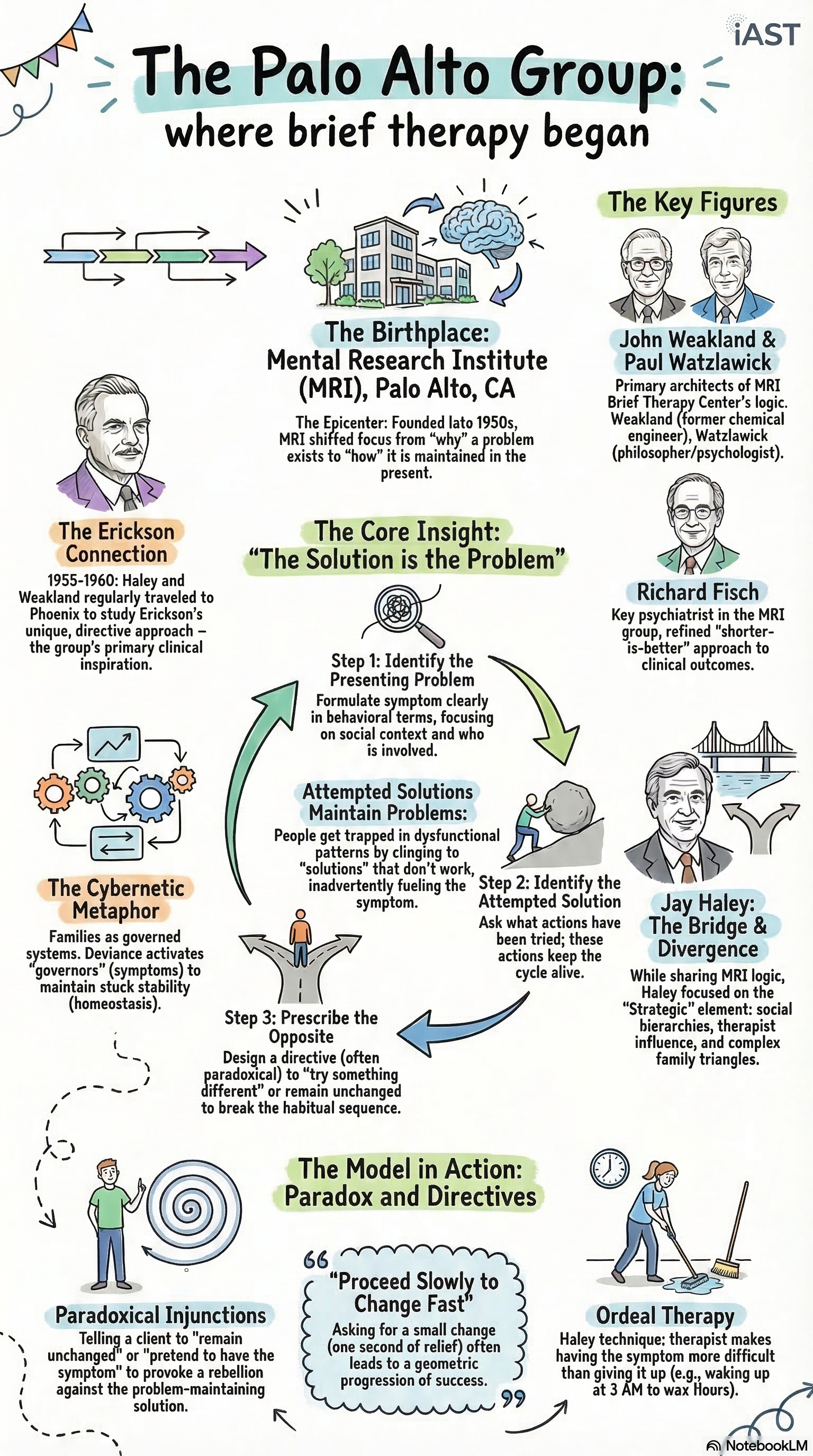
The second group was the Mental Research Institute, founded by Don Jackson in 1959. The MRI drew a different set of people: Paul Watzlawick, Richard Fisch, and (eventually) John Weakland, who moved from the Bateson project to the MRI after Bateson’s grant ended in 1962. Bateson himself declined to join the MRI. As Haley noted in Problem-Solving Therapy, Bateson “did not like his project to be confused with that group.”
The confusion persists because both groups operated in Palo Alto, both studied communication, and they shared overlapping personnel. But their intellectual orientations diverged. Bateson’s project was theoretical, focused on understanding the structure of communication. The MRI was clinical, focused on developing a practical model of brief intervention.
The MRI Brief Therapy Model
The MRI group developed a specific clinical framework that became enormously influential. The central insight, articulated most clearly in Change (1974) by Watzlawick, Weakland, and Fisch, was that problems persist because of the solutions people apply to them. The “attempted solution” becomes the problem.
A parent whose child refuses to eat tries harder to get the child to eat. The trying harder increases the child’s resistance. The resistance increases the parent’s effort. The problem is not the child’s appetite. The problem is the cycle of attempted solutions that maintains the pattern.
The MRI model prescribed interventions that interrupted this cycle, often by doing the opposite of what the client had been doing. Stop trying to force the child to eat. Tell the child that eating is optional. The intervention breaks the pattern because it removes the interactional fuel that keeps the pattern running.
The MRI's core insight: most problems persist because the solutions people apply to them make them worse.
Where Haley and the MRI Diverge
Haley’s strategic approach and the MRI model share the same intellectual ancestry, but they diverge on several points that matter in clinical practice.
The MRI model treats the problem-maintaining cycle as the unit of analysis. Identify the attempted solution, do the opposite, and the problem resolves. The model is elegant and often effective, but it operates primarily at the level of the dyad: the person with the problem and the person trying to help.
Haley’s approach, particularly as it developed through Problem-Solving Therapy and his work with families, treats the triangle as the minimum unit of analysis. Every clinical problem involves at least three people. The symptom-bearer, the person most affected by the symptom, and a third party whose involvement maintains the pattern. The MRI model can miss the third party, and when it does, the intervention fails because it addresses only part of the structure.
Haley also placed greater emphasis on hierarchy within families. Symptoms in children often signal a disorganized hierarchy: a parent who cannot set limits, a grandparent who overrides the parent, a marital conflict that recruits the child as an ally. The MRI model does not foreground hierarchy. Haley’s model treats it as the primary diagnostic frame.
Where They Converge
Both approaches share the premise that the presenting problem is the proper target of therapy. Neither group sends clients on archaeological expeditions into their childhood. Both treat therapy as a brief, focused intervention designed to produce behavioral change. Both regard the therapist as an active agent who designs interventions rather than a passive observer who facilitates insight.
Both groups also recognized the therapeutic power of paradox. The MRI’s technique of prescribing the symptom (telling a client to continue doing the thing they came to therapy to stop doing) is a form of paradoxical intervention. Haley formalized this technique in Strategies of Psychotherapy and expanded it in Ordeal Therapy. The clinical logic is the same: if the therapist controls the symptom by prescribing it, the client’s resistance can no longer maintain it.
The MRI and Haley’s strategic therapy represent two branches of the same clinical tradition. Practitioners trained in one approach benefit from understanding the other, because the two frameworks illuminate different aspects of the same relational structures. The MRI is stronger on analyzing problem-maintaining cycles. Haley is stronger on reading hierarchical structures and triangles. The competent strategic practitioner uses both.