Contents
In short
Strategic planning for a therapy practice is the decision about which business model the practice runs on, which clinical problem it solves, and where its referrals come from. Four variables decide whether the practice fills:
- The model. Open-ended retention work, or brief work that closes cases.
- The niche. A crowded slice of the market, or an underserved problem with few trained practitioners in it.
- The method. A framework built for slow exploration, or one designed for short, problem-specific results.
- The referral source. Paid acquisition, or word of mouth from clients whose problem resolved.
The rest of this page argues for the second option in each pair.
Most strategic planning for therapy practices ends up as a marketing plan. Pick a niche, build a website, claim the Psychology Today profile, post twice a week, maybe run a few ads. The plan treats an empty caseload as a traffic problem, as if the only thing missing were more people seeing your name.
The practitioners with full practices mostly skipped all of it. iAST’s graduates run full caseloads without advertising and without social media, the same way the institute always has. They are working a different model, and the model is the line of the plan almost no one writes down.
Two businesses hide inside the word therapy
Two businesses operate under the same license, and they have almost nothing in common.
The first runs on retention. The work is open-ended, sessions continue as long as the client keeps booking, and revenue depends on holding a roster of people on the calendar week after week. When someone finishes or drifts off, the slot has to be refilled, so the practice is always marketing to replace what it loses. Income is capped by the hours in the week. A full calendar is as good as it gets.
The second runs on throughput. The work is brief and aimed at a specific presenting problem. Cases resolve, clients leave, and the ones who got what they came for send other people. The practice fills from results, and the constraint stops being how to find clients. It becomes how to fit them all in.
iAST has always taught the second model. A strategic case runs a handful of sessions, closes, and produces the next referral. The referrals come out of the clinical work itself. Build a practice on cases that close, and the next client is usually one the last client sent.
A full practice is a positioning problem
A practitioner can be excellent at the work and still sit with empty hours, while someone weaker across town keeps a waitlist.
The variable is position. Most therapists chase the same clients, the everyday anxiety and relationship work, in the most crowded slice of the market, with the tools every other therapist is using. There are thousands of them inside a search radius of any given client. Advertising into that crowd is expensive, and it brings the most price-sensitive, least committed clients, the ones who cancel the week the fee comes up. More marketing buys more of the wrong clients.
The fix is to stop competing where everyone competes. A practitioner who is the obvious choice for one specific problem does not have to outspend anyone. The clients, and the referrals, go to whoever is known for one thing. The question is which thing.
The niche that fills a waiting list
One niche fits the brief, referral-based model better than anything else on offer right now: chronic pain with no clear medical cause.
The numbers are not subtle. More than a billion people live with chronic pain, and a large share of those cases have no structural problem that medicine can find or fix. These people spend years cycling through GPs, physiotherapists, pain clinics and imaging. Almost none of them get routed to anyone trained to treat the psychological side, because almost no one is trained to treat it.
The market behaves unlike the rest of therapy. A depressed client usually picks one therapist and stays. A chronic pain client sees a physiotherapist, a pain consultant, an acupuncturist and a neurologist at the same time, and commits to none of them. The practitioner who enters that field is not competing with other therapists for the case. There are no other therapists there. There is a gap.
This is the work Pain Resolution Therapy trains practitioners to do. PRT applies the strategic method to psychosomatic pain: find what the pain is doing in the person’s life and treat that, rather than managing the symptom for years. When it lands, it lands fast, and fast relief in someone who has hurt for a decade travels by word of mouth quicker than anything else in the field. The practitioner who gets a handful of these cases right does not have an empty calendar to fill. They have a waiting list they can barely keep up with.
The method that makes results worth referring
Fast results are not a personality trait. They come from a method built to produce them.
Strategic therapy, the framework iAST certifies, treats the presenting problem as the target. The practitioner reads the pattern holding the problem in place, assigns a directive to break it, and watches whether the pattern shifts. No open-ended exploration, no waiting for insight to surface. The work is brief by design , and that design is what produces the referrals. A client whose problem actually went away tells people it went away.
The Applied Strategic Therapy certification teaches the method from the ground up, including to people with no prior clinical background. The clinical skill and the full practice turn out to be the same thing from two angles. One produces the result. The other is what the result builds.
The referral strategy, written down
That leaves the practical question the model raises: how do the referrals start in the first place. Two sources, and neither one is an ad. Practitioners stuck in high-burnout corners of the field hand off the cases they cannot move, the resistant and the chronic, and they are glad to do it. And a small amount of pro bono work seeds word of mouth among people who later refer the clients who pay.
iAST put the whole approach in a short book, the one graduates get when they finish the training.
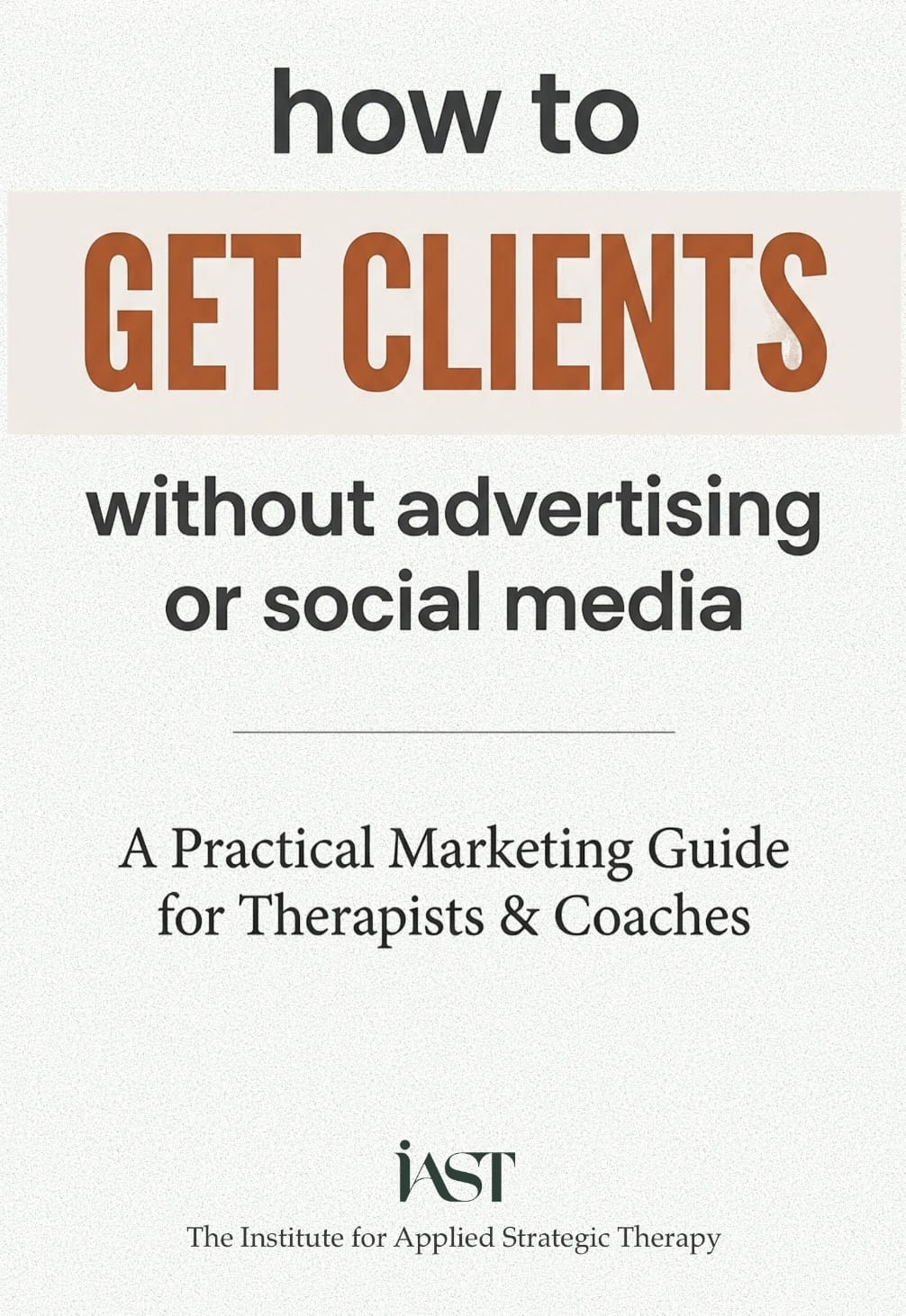
How to Get Clients Without Advertising or Social Media
You can be good at therapy and still have an empty calendar. This book is about why. It is a positioning problem: most practitioners compete in the most crowded slice of the market, with the tools least suited to how clients choose a therapist. The book makes the case for standing somewhere else. It covers the underserved niche where demand outruns the supply of trained practitioners, and the two referral sources that fill a private practice without advertising. 128 pages, written for practitioners who already carry a caseload and have no patience for marketing theory.
Common questions
Does strategic planning for a therapy practice require a marketing budget? No. Practices built on brief, problem-specific work fill from resolved cases, not from advertising. The referral mechanics are covered in detail at Does Advertising Work for Therapists?
What is the best niche for a strategic therapy practice? Chronic pain with no clear medical cause. The demand is large, the supply of trained practitioners is small, and resolved cases refer at a rate other niches do not match. See What Is the Best Niche for a Therapy Practice?
How do strategic therapists find clients without social media? Two sources. Burned-out practitioners hand off resistant and chronic cases. A small amount of pro bono work seeds word of mouth among people who later refer paying clients. The full method is covered at How to Find Clients for a Private Practice
How short is a strategic therapy case? A handful of sessions, designed to close. The method targets the pattern holding the problem in place rather than running open-ended exploration. See Brief Therapy: How Short Is Short Enough
Where this leaves your plan
Strategic planning for therapy practices usually argues about fees, hours, software and which directory to pay for. Those decisions matter at the margin. None of them moves the practice the way the model and the niche do.
A practice built on brief, problem-specific work in an underserved niche fills itself, because every resolved case is the start of the next one. That is the whole plan. The clinical training is the Applied Strategic Therapy certification . Pain Resolution Therapy is the niche that fills fastest, and the referral mechanics are the book’s entire subject. iAST has also written separately on building a strategic practice day to day .
One honest line, since the rest of the field is not always honest about it. The AST and PRT certifications train you in a method. They are not a clinical license, and where you practice and with whom is governed by the rules of your jurisdiction, which you sort out for yourself.
Build a practice that fills itself
The AST and PRT certifications train practitioners from the ground up, including career changers with no clinical background. The model is brief and the niche is underserved, which is why the practice fills by referral instead of by advertising. Get in touch for a free consultation.