Jay Haley had more to say about psychoanalysis than about any other therapeutic tradition. His engagement with it was sustained, detailed, and unsparing. The epilogue to Strategies of Psychotherapy is titled “The Art of Psychoanalysis,” and it reads like a communication analyst dissecting a relational strategy that its practitioners refuse to acknowledge as strategic.
The comparison is not academic. These two approaches represent fundamentally different answers to the most basic clinical question: where does change come from?
The Fundamental Difference
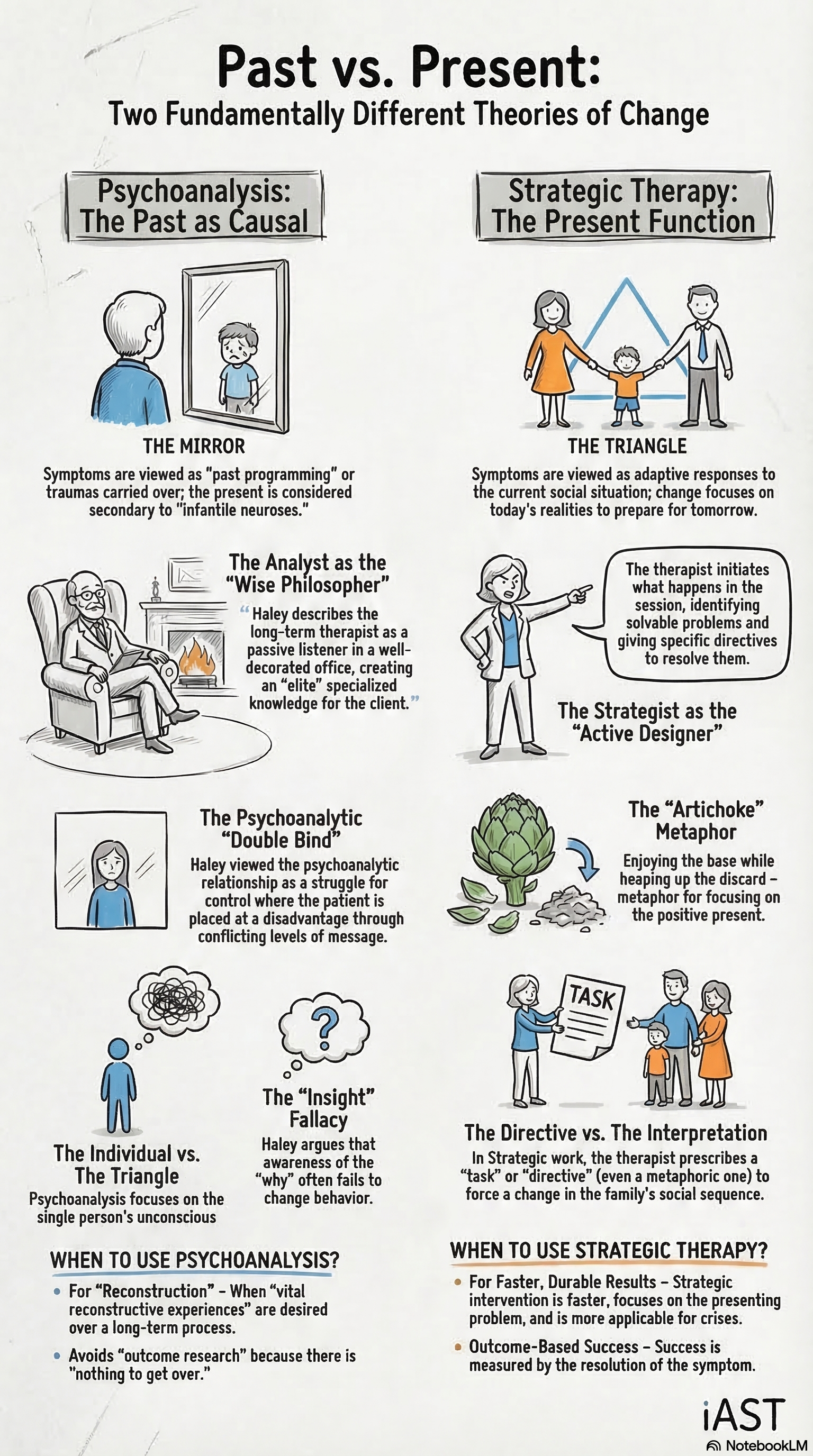
Psychoanalysis treats the past as causal. Symptoms arise from unresolved conflicts, typically originating in early childhood, that persist in the unconscious and express themselves through symptomatic behavior. The therapeutic method is archaeological: excavate the unconscious, bring the conflict into awareness, and resolve it through interpretation and the working-through process. Change follows understanding.
Strategic therapy treats the present function as the target. Symptoms are maintained by current relational patterns, and the relevant question is not “Where did this come from?” but “What is this doing now?” The therapeutic method is structural: identify the pattern, design an intervention that alters the pattern, and evaluate whether the symptom remits. Understanding is optional.
These are not two perspectives on the same thing. They are incompatible premises about the nature of human problems.
What Haley Observed
Haley’s analysis of psychoanalysis was not primarily about its theory. It was about what actually happens in the psychoanalytic relationship. He observed that the analytic setup, the couch, the silence, the refusal to answer questions, the neutrality, constitutes a specific relational strategy. The analyst controls the relationship by declining to participate in it on the client’s terms. The client is put in a position of dependency and uncertainty. The analyst interprets this dependency as “transference” and treats it as clinical material.
Haley pointed out that this is a strategic move, whether the analyst recognizes it or not. The analyst who claims neutrality is exercising a form of influence that shapes the client’s behavior in session. The difference between the psychoanalyst and the strategic therapist is not that one influences and the other does not. The difference is that the strategic therapist acknowledges the influence and designs it deliberately.
Every therapist influences the client. The question is whether the influence is deliberate and designed, or accidental and unexamined.
Time and Cost
The practical differences are substantial. Psychoanalysis operates on an extended timeline. Classical analysis involves three to five sessions per week for several years. Modern psychodynamic therapy is less intensive but still expects treatment to last months or years. The time commitment reflects the model’s premise: insight develops slowly, and working through unconscious material requires sustained effort.
Strategic therapy expects to produce change in ten sessions or fewer for most presentations. The time difference is not a concession to efficiency. It follows from the method’s premise: if the problem is maintained by a current pattern, changing the pattern produces immediate results.
The cost implications are obvious. A client in twice-weekly psychodynamic therapy for two years accumulates a cost that a client in ten sessions of strategic therapy does not. For some clients and some presentations, the extended investment may be worthwhile. For most, it is unnecessary.
When Psychoanalytic Work Is Appropriate
There are clients and presentations for which psychodynamic exploration has genuine value. Clients with complex trauma histories who have difficulty forming relationships may benefit from a sustained therapeutic relationship that allows attachment patterns to emerge and be addressed over time. Clients with personality disorders that involve chronic interpersonal instability may need the extended frame that psychodynamic therapy provides.
Strategic therapy does not claim to be the right approach for every client. It claims to be the right approach for the majority of presenting problems, and the evidence supports that claim. Where long-term work is indicated, the strategic practitioner recognizes it, adjusts the treatment plan, and may refer to a psychodynamic colleague when the case calls for a different orientation.
What the Comparison Reveals
The strategic critique of psychoanalysis is not that it fails entirely. Some clients benefit from it. The critique is that it mistakes its method for the only serious form of therapy, and it treats brevity as superficiality. Haley’s career was, in part, a sustained argument against this position. Change does not require excavation. It requires intervention. A practitioner who understands the presenting problem, identifies the pattern that maintains it, and designs a directive to alter the pattern can produce durable clinical results in a fraction of the time.
The results are not superficial. Research on brief therapy outcomes consistently shows that gains made in ten sessions are maintained at follow-up. The accusation that brief therapy treats symptoms without addressing underlying causes assumes that symptoms have underlying causes in the psychoanalytic sense. Strategic therapy rejects that assumption. The symptom is the problem. Change the pattern, and the problem resolves.